Cultural Regression to the Mean
Thesis
Optimise anything at a large enough scale, and it will converge towards the same answer. This has been quietly true for sport, architecture, branding, cinema, and music over the last two decades, and the evidence is now extensive enough call it a pattern rather than a coincidence.
AI has not introduced this force, it inherits it and then applies it at a deeper and deeper level. Culture has spent twenty years being optimised: curated, tested, A/B tested all served by up algorithms. AI is now positioned to generate it directly, at near-zero marginal cost, using the exact same logic that has converged everything else. This is the part that is worth paying attention to, because it's also where the opening for a counter-trend starts.
The Moneyball Logic
The film Moneyball is one of my top 10 favourites, the idea that data informs real world actions so completely that it shaped the structure of a baseball team fascinated me so much that I watched it on loop during a trip to Florida when it was initialy released.
However, basketball is one of the clearest illustration of this in sport because the optimisation is visible in near real-time action. Once teams had started using data, the mathematics were unambiguous: a shot just inside the three-point line is worth less, in terms of expected value, than a shot just outside, or one taken right at the rim. There is no expected value reason for shooting from mid-range.
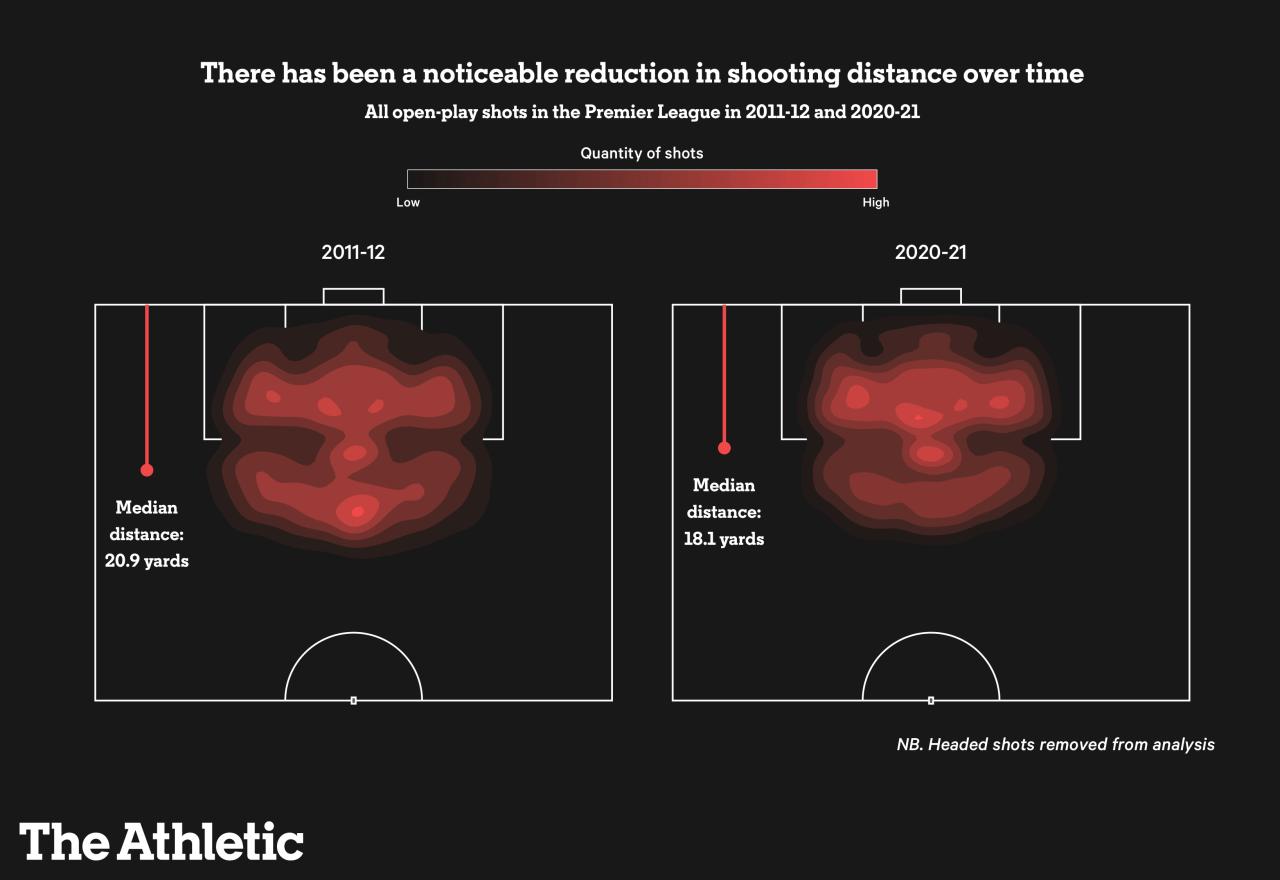 NBA Shooting Distance Has Decreased Over Time
So the mid-range shot has almost disappeared from the NBA. Every team, using the Moneyball logic, has arrived at the same optimised strategy because there is only one expected value answer once you start measuring.
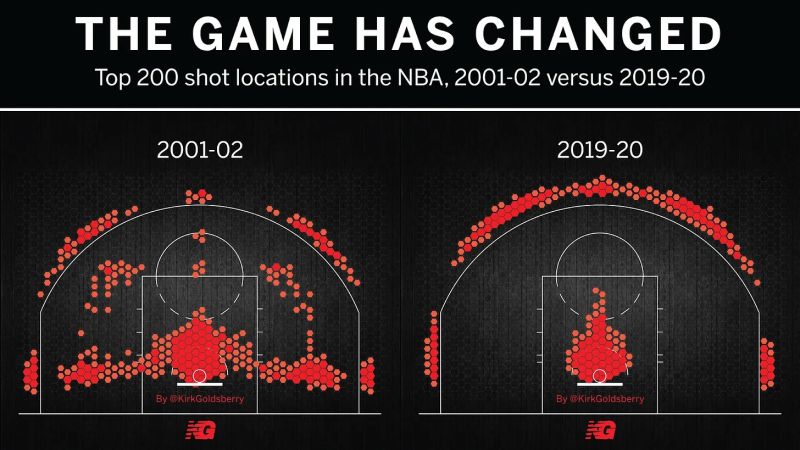 THE GAME HAS CHANGED
This is the mechanism in a microcosm: give a system a metric and enough iterations, and it will converge on whatever maximises that metric, discarding variation that don't create expected value. Sport is simply the domain where you can see it happen most quickly because the feedback loop (win or lose) is immediate and brutal.
Design Converged First
The articles by Alex Murrell on this topic are the most fascinating summary of the same pattern outside of sport, and it deserves a review because it's not anecdotal.
- Interiors: The same AirSpace aesthetic (white walls, Edison bulbs, reclaimed wood, hanging plants) appear identically in Airbnb rentals, cafes, and co-working spaces from Brooklyn to Berlin, from Tokyo to London. This is not a coincidence; it's what performs best in a listing photo or on Instagram.
- Architecture: Global cities are filling up with nearly identical apartment blocks (squares, beige, cheap cladding) because planning, construction costs, and financing constraints steer all developers towards the same handful of viable floor plans and designs.
- Cars: Optimisation in test tunnels for energy efficiency has led to a visual convergence of SUVs across all manufacturers. Separately, 80% of cars sold in 2016 were monochrome (black, white, silver, or grey), compared to only 40% twenty years earlier.
- Branding: What the design writer Elizabeth Goodspeed calls "homogenisation": the identical sans-serif logo, pastel palette, and rounded, friendly illustration style adopted by dozens of unrelated tech companies. At least 27 brands have aligned themselves to a version of the slogan "Find Your X".
- Faces: Plastic surgeons report that patients bring the same reference photo: one surgeon stated that about a third of their clients request "Kim's" cheekbones, lips, and jawline. Filters and FaceTune do the same job for everyone who cannot afford surgery. This has been ironically nicknamed "Instagram Face".
None of these industries have coordinated with each other. They didn't need to, each ran its own version of the three-point-line calculation and ended up in the same place because the test penalises anything distinctive. Steven Soderbergh said the same about film marketing: test a poster or trailer against a broad audience, and the elements that make it interesting are precisely those that score the lowest and are cut.
Entertainment Ran the Same Experiments
Film and music are where convergence is easiest to feel, and the data backs this up.
Since 2010, more than half of the 20 most highest-grossing domestic films in any given year have been sequels, remakes, or franchise instalments, compared to only about a quarter before 2000. In 2021, only one of the top ten domestic films was an original story. Recent years have kept the pattern intact: the most profitable film lists are dominated by Marvel entries, franchise sequels, and adaptations of existing intellectual property. Barbie and Super Mario are only considered exceptions because the underlying property predates the industry's optimisation era itself.
Alex Murrells' follow-up article on music shows the same outcome measured differently:
- An analysis from 2018 revealed that the average song on the Billboard Hot 100 had dropped from about 4:10 in 2000 to around 3:30. The top 50 songs of the year's Hot 100 in 2021 averaged 3:07. Songs under three minutes have dropped from 4% of the top ten in 2016 to 38% in 2022.
- Musical intros (the passage before the vocals or chorus arrive) have dropped by about 80% in thirty years, falling from 20 to 25 seconds in the mid-80s to around 5 seconds today.
- Key changes, once present in about 30% of hits in the 90s, now appear in single figures.
- A similarity analysis based on song lyric compression has shown that songs have become measurably more repetitive between 1960 and 2015, with several of the biggest pop stars of the 2010s being among the most repetitive ever recorded.
The cause in both cases is not a mystery. Streaming platforms pay per stream and a stream counts once a listener spends about thirty seconds. So shorter songs and front-loaded songs simply gain more per unit of writing effort. Studios approve sequels because the box office of a sequel is a known figure and that of an original script is not. In both industries, the instinct to optimise for what already works is not a creative failure by the studios standards. It is the correct move for anyone who is measured on the metric they are actually being evaluated against.
The Social Feed is the Mechanism in Action
Patrick Ryan specifically addressed short-form video in his article: where it adopted moneyball logic and it turned it into a product. TikTok, YouTube Shorts, and Reels exist to find, in milliseconds, the version of content most likely to capture your attention for the next six seconds, then serve you its nearest neighbours indefinitely. There is no measured trial and error cycle by quarters or weeks of ranking here: it is a direct and continuous optimisation loop running against your attention, re-evaluating every time you scroll.
The result is a feed that looks less like discovery and more like sedation: content sufficiently different not to be a repetition, yet similar enough to guarantee the next six seconds of engagement. It is the Moneyball logic with the compressed feedback loop of years into milliseconds. That's exactly why it works so well, and that's exactly why it produces the most homogenous media environment to date.
AI is the Same Logic, One Layer Deeper
Everything above describes the optimisation applied to selection, which film is funded, which song is promoted, which video will be served next. The raw material selected came, at least, from humans doing something other than pure optimisation.
AI changes the layer on which the optimisation operates. A model trained to produce trending content no longer needs to select from a pool of human made options. It can generate directly for the metric, at effectively zero marginal cost, without creative instinct in the loop to resist the pull towards the average. The Moneyball logic that took over architecture, branding, cinema, and music each a decade or two to fully converge can now be applied to content generation itself instantly, at any scale desired by a platform.
This is the "steroid injection" version of the trend built since the 2000s: not a new force, but the removal of the last constraint (human effort) that slowed down the old way.
Where the Counter Trend Opens Up
The interesting aspect is what this regression to the mean highlights in contrast. While AI generated and AI curated content becomes the ambient norm, anything that visibly required a human and could not be optimised to existence gains a kind of value it didn't have when it was simply the normal way of doing things.
This resurgence is already visible at the margins:
- Handwritten letters and paper cards, explicitly positioned against instant digital messaging.
- Art, dance classes, and book clubs: activities whose entire value resides in their physical presence with other people.
- Handmade items from Etsy, marketed specifically on imperfection rather than despite it.
- Small group travel and shared experiences, sold through an authentic human company rather than convenience.
None of these is nostalgia for its own sake. It is a rational response to scarcity, when everything else has been optimised towards the mean the un-optimised becomes the differentiator. The companies and creators worth watching in the coming years are not those rushing to surpass AI which will always surpass them. It is those building around the unique entry point that resists the pull toward the mean. A real human undeniably present in what they have created.
Inspired by and drawing on data from Alex Murrell's The Age of Average and The Age of Average (Encore), and Patrick Ryan's Greetings From The Future, It's Really F***ing Boring.